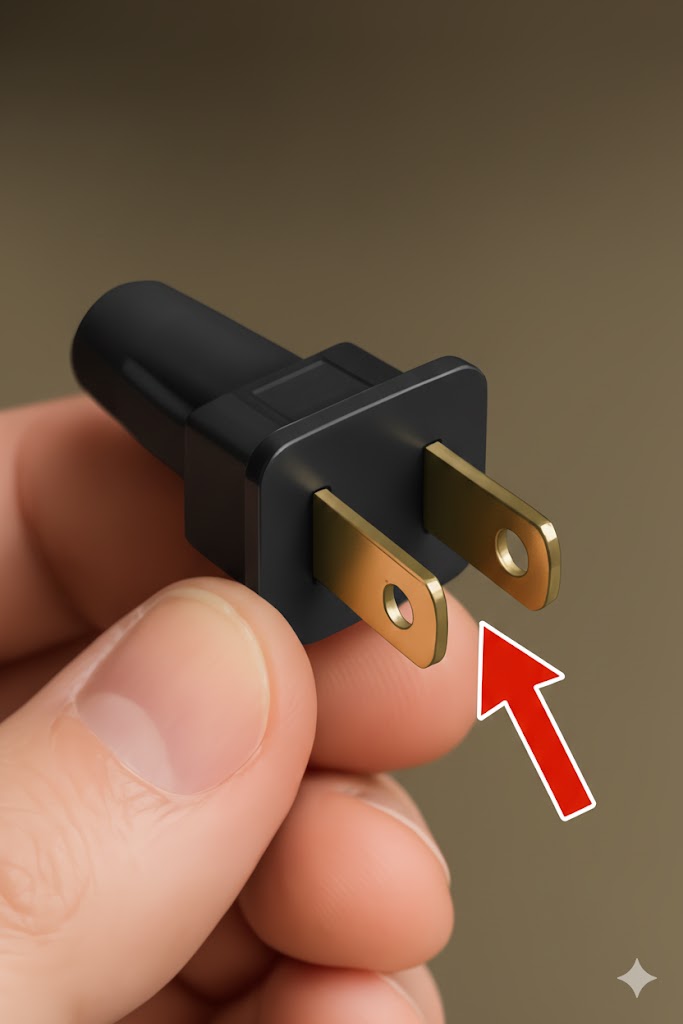
Why does orientation matter so much? Many decorative lights and household appliances (like toasters or lamps) are designed so that the "hot" wire is buried deep inside, while the neutral wire is connected to the outer, more accessible parts.
- If plugged in correctly: The outer parts of the light socket are connected to the neutral wire. If you touch them, you are safe.
- If plugged in incorrectly: The outer metal parts could become "live." If you touched a light socket while standing on a damp floor or reaching for a metal gutter, you could become the path to the ground for that electricity.
4. Why Holiday Lights Need This More Than Anything
Christmas lights are unique because they are often used in high-risk environments:
- Outdoor exposure: Rain, snow, and ice increase conductivity.
- Long chains: Connecting multiple strands together creates more opportunities for electrical faults.
- Frequent handling: We touch, hang, and adjust these lights more than almost any other electrical device in our homes.
The polarized plug ensures that even if a bulb is missing or a wire is slightly frayed, the risk of the entire strand becoming a "hot" hazard is minimized.
5. The Dangerous "Hack": Never File Down a Prong
In older homes built before the 1960s, you might find outlets where both slots are the same size. Never file down the wide blade of a plug to make it fit into an old outlet. Filing down the prong bypasses every safety standard mentioned above. It’s better to buy a cheap adapter or, even better, have a professional upgrade your outlet to a modern, polarized version. Bypassing this safety feature is one of the leading causes of holiday-related electrical fires.
6. The "UL" Seal of Approval
You’ve likely seen the UL (Underwriters Laboratories) tag on your light strings. This organization mandates the polarized plug design. When you see that wide prong, you are looking at decades of fire-safety research and engineering aimed at preventing the thousands of electrical accidents that used to happen every December before these standards were enforced.
7. Two Prongs vs. Three: What’s the Difference?
While many large appliances have three prongs (the third being a "ground" wire), Christmas lights usually only have two. Because they are double-insulated or designed for low-wattage use, they rely entirely on polarization (the wide prong) as their primary defense against shocks.
Summary: A Tiny Detail with a Big Job
The next time you’re untangling a mess of lights and struggling to get the plug into the wall, take a moment to look at that wide prong. It’s a quiet reminder that even the smallest design details in our homes are working around the clock to keep us safe. It’s the perfect balance of form and function that allows us to enjoy the glow of the holidays without worry.