Garlic’s main health-boosting ingredient is a natural sulfur compound called allicin.
Allicin is formed when garlic is chopped, crushed, or chewed. This process activates enzymes that release the compound responsible for garlic’s strong smell — and many of its healing properties.
Scientific studies show that allicin can:
-
Inhibit bacterial growth
-
Damage harmful microbes
-
Reduce inflammation
-
Support immune response
-
Act as an antioxidant
In laboratory experiments, allicin has demonstrated effects against several harmful organisms, including:
-
Escherichia coli (E. coli)
-
Salmonella
-
Staphylococcus aureus (including MRSA strains)
-
Helicobacter pylori (associated with stomach ulcers)
-
Klebsiella species
These results clearly prove that garlic has antibacterial power — but it’s important to understand how these tests are done.
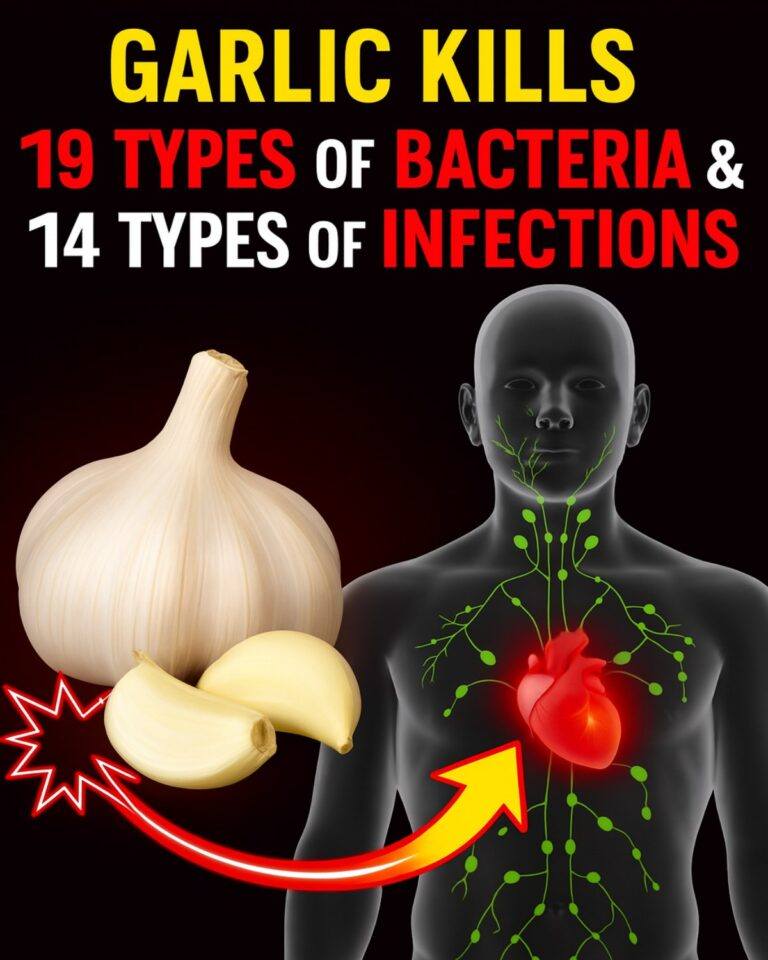
Does Garlic Kill Exactly “14 Bacteria and 13 Infections”?
This claim is not scientifically accurate.
There is no medical study, university research, or official health organization that has verified a list stating garlic kills exactly “14 bacteria and 13 infections.” This number does not appear in:
-
Scientific journals
-
Medical databases
-
WHO publications
-
Hospital guidelines
-
Academic research
Instead, this number mostly appears in:
-
Viral social media posts
-
Alternative medicine websites
-
Unverified blogs
While garlic can affect many microbes in lab conditions, science does not support the idea of a precise “kill list” of microbes.
So the truth is:
✅ Garlic DOES have antimicrobial properties.
❌ The number “14 bacteria and 13 infections” is exaggerated and misleading.
Garlic’s Anti-Fungal & Anti-Viral Potential
Continue reading by clicking the ( NEXT 》 ) button below !